
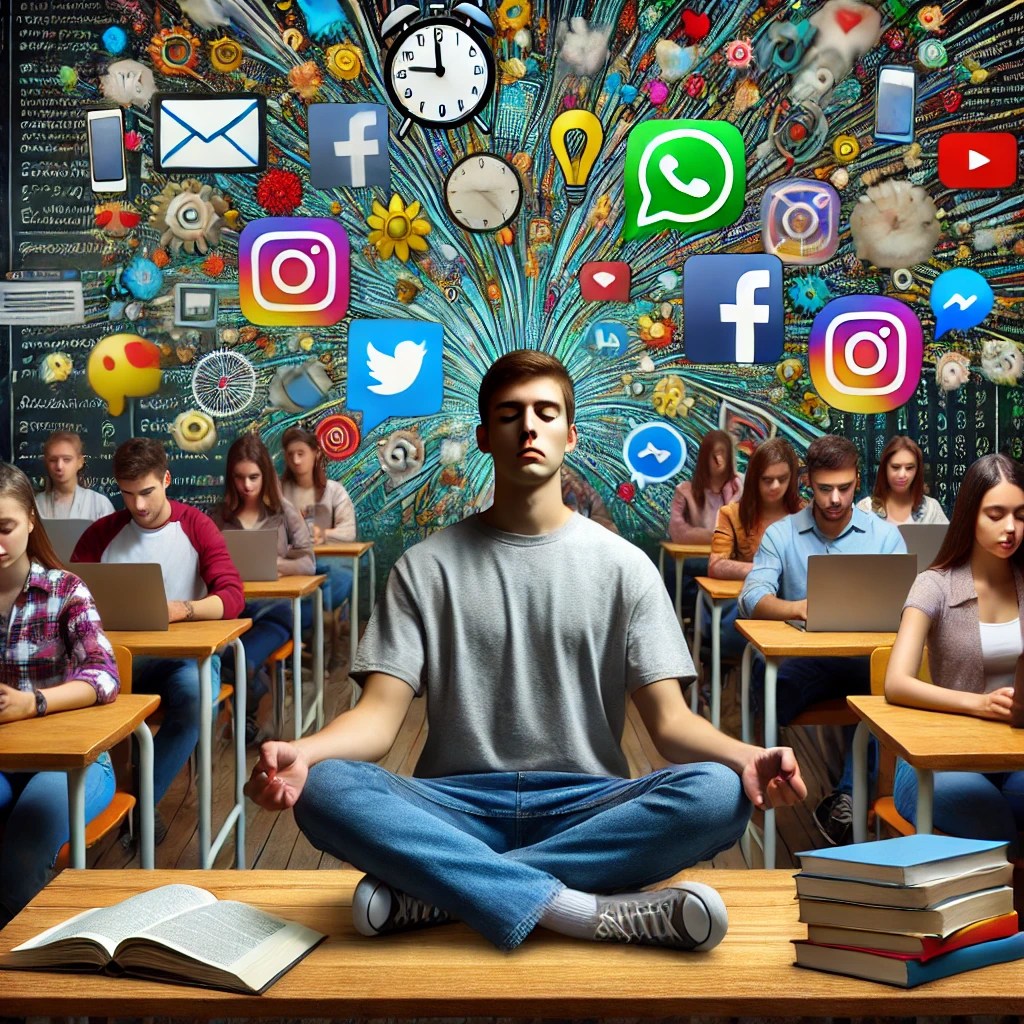
Attention, in this technology-driven world, is becoming a big problem for students, parents and educators as the ability to focus for extended periods is becoming increasingly rare. Kim Mills, host of the “Speaking of Psychology” podcast, interviews Dr. Gloria Mark, chancellor’s professor of informatics at the University of California, Irvine, about the effects of technology on attention. Mark has focused her studies on attention and found that attention spans have steadily declined over the years (Mills, 2023), raising concerns about the effects on education and learning. This issue is particularly troubling for students who already struggle to concentrate in class, retain information, and stay engaged. As distractions grow—whether from digital devices, social media, or overstimulating environments—educators are left searching for effective strategies to help students regain their focus. This paper explores the decline in student attention spans, its impact on learning and retention, and the potential of meditation as an innovative solution to combat this growing problem.
Attention span is defined as “the length of time for which a person is able to concentrate mentally on a particular activity” by the Oxford Languages dictionary. According to Dr. Gloria Mark our attention spans have gone from the ability to focus on a task for two and a half minutes in 2002, dropping to 75 seconds by 2012, and averaging out to about 47 seconds in recent years (Mills, 2023). This is an average, and ranges will differ from children to adults, but the trajectory is clear and consistent, and it’s not going up. Factors contributing to shorter attention spans are not just limited to digital devices either. Sandee LaMotte, a journalist for CNN, shares her findings from Dr. Gloria Mark’s book Attention Span: A Groundbreaking Way to Restore Balance, Happiness and Productivity (2024). LaMotte suggests that our minds drifting and jumping from task to task also adds to the problem of shortened attention spans (2024). Students confirm this in self-reported surveys collected by the independent market research platform, Gitnux. About 75% of students admit that they are distracted by social media during study time, while 70% say their attention is sidetracked by notifications (Gitnux, 2024). According to the survey, teachers are also in agreement that technology isn’t helping attention spans, with 85% saying, “internet and digital technologies are creating an easily distracted generation” (Gitnux, 2024).
The inability to focus raises concerns, not just for individual productivity but also for education, where maintaining focus is crucial for learning. The impact on young children is even worse, as Mark says, “when children are very young, they’re a lot more susceptible to distraction than older children. And when they’re distracted, it takes them longer to get back and focus again” (Mills, 2024). The games and entertainment available these days are all short scenes, colorful, fast-paced, and every minute is packed with content. When scrolling on TikTok or YouTube, videos are quick, straight to the point, and natural gaps between dialogue are cut out, making sentences back-to-back with no process time. Kids are getting used to information being delivered in this way and have a hard time staying engaged when it slows down, like in a classroom. The added challenge for educators is that even if they can get students to focus on them in the classroom, students aren’t as engaged because real life isn’t as immediate or exciting as their entertainment. With attention spans dropping, academic performance also decreases, and it’s this that poses a challenge to educators who want to keep their students engaged. Now, teachers and educators have the problem of trying to impart knowledge in smaller, bite-size chunks at faster rates in an attempt to hold their students’ attention.
So, what is the solution to this problem? As it turns out, there are a few methods schools, educators, parents, and students can try to increase attention spans, including “taking sufficient breaks, doing mindfulness meditation, and trying to monotask, as opposed to multitask” (Schelenz, 2024). Mindfulness meditation has already been on the general public’s radar as a solution to mental health, and some schools have taken it one step further by incorporating mindfulness exercises into their daily routines to help their students become more mindful at school. Andy Minshew, in his article How To Maintain Your Students’ Attention In Class emphasizes that mindfulness meditation helps students become more aware of their thoughts and emotions, improving their ability to concentrate (Minshew, 2022). Associated Press’ investigation confirms these findings. They discovered that schools implementing meditation programs, such as the Inner Explorer Program, saw positive effects on student well-being and focus. Students have even voiced their appreciation of the program’s benefits, as 9-year-old Aniyah Woods, a student using the Inner Explorer Program, shares that it “has helped her ‘calm down’ and ‘not stress anymore.’” (Associated Press, 2024). While more research is needed to measure the long-term impact of these programs, early findings suggest that teaching students how to focus with techniques like meditation—not just demanding it—could be key to tackling the shrinking attention span problem.
While meditation programs give educators hope to regain student focus, the need for their growing presence in schools highlights a broader issue—the urgent necessity for strategies that counteract the decline in attention spans. This decrease in focus has become a major challenge in education, making it harder for students to absorb information and for teachers to engage them effectively. Studies indicate “that over the past couple of decades, people’s attention spans have shrunk considerably,” making it more difficult for students to concentrate in class, absorb information, and stay engaged (Mills, 2023). This decline has led to significant challenges for educators, who must now adapt their teaching methods to maintain student focus. As distractions continue to grow, many experts suggest mindfulness and meditation as potential solutions. Research shows that meditation can help improve focus by training the brain to manage distractions, fostering better concentration, and enhancing overall cognitive function (Minshew, 2022; Associated Press, 2024). If educators are successful at reining in attention and refocusing it on the material at hand, Students will be able to absorb and understand the content effectively, which in turn would lead to better academic scores. Knowing that daily mindfulness meditation is already an effective tool for mental health and metacognition, what would the harm be in adding it to the school’s curriculum? Imagine school as a place where all students had the opportunity to learn how to refocus when distracted, allowing them to say, “This has calmed me down” and “I don’t stress anymore.”
~ J
References
Associated Press (2024, August 4) More US Schools are Taking Breaks for Meditation. Teachers Say it Helps Students’ Mental Health. U.S. News. https://www.usnews.com/news/best-states/georgia/articles/2024-08-04/more-us-schools-are-taking-breaks-for-meditation-teachers-say-it-helps-students-mental-health
Gitnux. (2024) https://gitnux.org/students-attention-span-statistics/
Jackson, T. (2024, August 23). Educators work to combat a student attention span crisis.https://www.wvva.com. https://www.wvva.com/2024/08/23/educators-work-combat-student-attention-span-crisis/
LaMotte, S. (2024, May 15). If you think you can’t focus for long, you’re right. CNN Health. https://edition.cnn.com/2023/01/11/health/short-attention-span-wellness/index.html
Mills, K. (2023, February) Why our attention spans are shrinking, with Gloria Mark, PhD.. APA.org. https://www.apa.org. https://www.apa.org/news/podcasts/speaking-of-psychology/attention-spans
Minshew, A. (2022, October 24). Maintain your students’ attention in class.Waterford.org. https://www.waterford.org/blog/student-attention-span/
Schelenz, R. (2024, January 2). How to sharpen your attention and meet your goals in 2024. University of California. https://www.universityofcalifornia.edu/news/how-sharpen-your-attention-and-meet-your-goals-2024
 The Open Book
Leave a comment